

Latvia Financial Crime Dashboard – by FCN
A new and updated Financial Crime News publication for Latvia is now released.
See the Financial Crime Dashboard as of May 2026. See below:
For more on Latvia See HERE
New UK Fraud Strategy – (2026 – 2029)
The UK has published its new Anti Fraud Strategy (2026 -2029), which like the last one published in 2023 has much to commend it. The highlight is the Online Crime Centre a public private collaboration that is at last following the Anti Scam Centres set up up by leading countries in Asia including Singapore in 2019 and more substantively in 2022.
It has though one glaring omission. It has no target. This may be because the previous Strategy had one but that didn’t work out so well, so maybe the idea of setting targets has been shelved. No one is disputing lots of effort went into tackling fraud under the last strategy or will in this one.
Still it’s important to remind ourselves what the target was in 2023, otherwise it will be forgotten and the lessons won’t be learned.
From Potentates to PEP’s – A 50 year Journey
It is 25 years since the term “Politically Exposed Persons” was first used publicly, and it came from the Chairman of the Swiss Banking Regulator in an address to the Basel Committee on Banking Supervisors in Basel on 21st September, 2000. The need for such a term and to ensure collective international action arose from the experiences of Banks and Banking and their exposures to funds derived from grand corruption largely overseas, dating back to the 1970’s though to the end of the 1990’s.
It is instructive to review the timeline that both led to the genesis of the term “Politically Exposed Persons” which could instead have been “Potentate Risk”. The experiences in Switzerland in particularly and the reaction by Swiss Regulators cannot be overstated to ensure it was internationalised first via the Basel Committee on Banking Supervision in 2001 and by the FATF in 2003 (First used as a term by FATF in May 2002).
Epstein Files: Financial Crime Case Study – Lessons Learned & Long Form Chronology - Premium
For a summary Financial Crime Case Study on the Epstein Files see HERE:
The Epstein Files:
When a plane crashes, an investigation is undertaken and a root cause is identified and lessons for the wider aviation industry are learned and new adaptations implemented.
Fighting financial crime should do the same, but “crashes” take years to investigate and partisan findings generate limited results which rarely means adequate programme adjustments are made.
The case of Jeffrey Epstein is a case in point. This is an almighty plane crash, where investigations everywhere are being mishandled.
Despite decades of suspicions and reporting of SARs he still maintained bank accounts and the financial intelligence that was identified appeared to have no material impact internally in some of the main banks he had accounts and or with those supervising and or from those receiving the intelligence which goes to the very heart of the system we all want to work better.
Epstein Files: Financial Crime Case Study – Lessons Learned
The Epstein Files:
When a plane crashes, an investigation is undertaken and a root cause is identified and lessons for the wider aviation industry are learned and new adaptations implemented.
Fighting financial crime should do the same, but “crashes” take years to investigate and partisan findings generate limited results which rarely means adequate programme adjustments are made.
The case of Jeffrey Epstein is a case in point. This is an almighty plane crash, where investigations everywhere are being mishandled.
Despite decades of suspicions and reporting of SARs he still maintained bank accounts and the financial intelligence that was identified appeared to have no material impact internally in some of the main banks he had accounts and or with those supervising and or from those receiving the intelligence which goes to the very heart of the system we all want to work better.
Sanctioned – A Jim Simons Thriller by John Cusack
Now published, “Sanctioned”, the 3rd book in the JIM SIMONS series. To order your copy in paperback or Kindle from Amazon, see HERE.
In 2003, the war on terror was in full flow and had taken an unexpected turn. Saddam Hussein’s Iraq had been invaded and the dictator’s regime had fallen in just a few weeks. Whilst the Americans and their allies were now in charge in Baghdad, they were still missing what they wanted most, the “Ace of Spades”, as he was known by US Intelligence. President Saddam Hussein had escaped and was still in hiding after more than 6 months. If he could stay a fugitive, he could bring together anti-colonial forces, and in time, lead the fight back.
Payback – A Jim Simons Thriller by John Cusack
The Blurb
In 1981 Andre Simons, the CFO for a Mexican telco, was kidnapped in Mexico City. He had found something and that was a problem. A ransom was paid. The kidnappers took the money, but still put a bullet in his chest and in his head. The heartbroken Simons family left to return to Switzerland.
Ten years on, Jim Simons was now 25 and was mentored by his father’s brother.
Malaysia – FATF Assessment – Highlights by FCN
The MALAYSIA FATF ASSESSMENT – HIGH LEVEL SUMMARY
In this 5th round, (2nd effectiveness round) the report (275 pages) on Malaysia is the first country assessment that has been published. Here is a very high level summary and some key data points.
- Main Period of Assessment 2019 – Feb 2025.
- On the 40 Recommendations, Malaysia had all Compliant and Largely Compliant Ratings.
- For Effectiveness, 6 were rated as Substantially Effective and 5 Moderately Effective. The Moderately Effective ratings were for IO2 International Cooperation, IO4 None FI Supervision & Preventative Measures, IO5 Transparency & Beneficial Ownership, IO7 ML Investigations, Prosecutions and Convictions, IO8 Asset Recovery.
- Highest risk predicates generating ML threats come from fraud, corruption, illicit drug trafficking, smuggling, and organised crime, followed by tax crimes, forgery, human trafficking/migrant smuggling, sexual exploitation, and environmental crime.
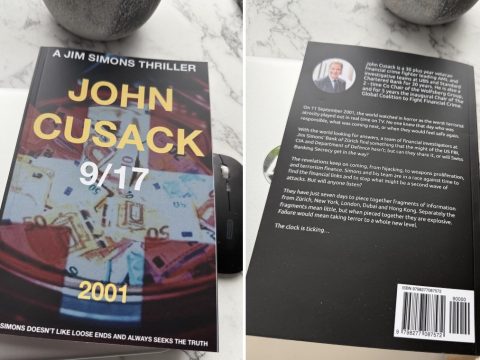
9/17 – A Jim Simons Thriller by John Cusack
A Jim Simons Thriller
On 11 September 2001, the world watched in horror as the worst terrorist atrocity played out in real time on TV. No one knew that day who was responsible, what was coming next, or when they would feel safe again.
With the world looking for answers, a team of financial investigators at Jim Simons’ Bank of Zürich find something that the might of the US FBI, CIA and Dept of Defence hasn’t; but can they share it, or will Swiss Banking Secrecy get in the way?
UK National ML/TF Risk Assessment – Summary, Commentary & Dashboard by FCN
The UK ML/TF National Risk Assessment 2025 dropped last week and is a welcome update on those reported in 2015, 2017 and 2020. The NRA runs to 163 pages and provides a summary of the main ML & TF threats and trends since 2020 as well as summarising the most vulnerable sectors and highlights some interesting cross cutting issues.
1. Money Laundering: The main ML related threats are identified as being the “common predicate offences that generate criminal funds” and “harms” since 2020 which come from: “Fraud, Sanctions Evasion, Acquisitive Crime, Drugs, Cybercrime, Organised Immigration Crime (OIC), Tax Evasion, Modern Slavery & Human Trafficking (MS/HT), Online Child Sexual Exploitation & Abuse, Environmental & Bribery & Corruption”. The changing threat landscape reflects the following:
- The UK’s open economy
- The size of the UK’s financial centre and its related professional services
- The use of cash based money laundering remains high despite the decline in the everyday use of cash
- Geopolitical changes including those that have come fro Russias invasion of Ukraine
- The continued vulnerability in some traditional financial and professional services, as well as through UK companies.


